2012
Pamela A. Marshall, Nicholas Netzel, Jillian Wisby Guintchev. Assessing compensation for loss of vacuolar function in Saccharomyces cerevisiae. 2012. Canadian Journal of Microbiology, 10.1139/w11-114.
2011
Brianna Brianna Pearson*, Sam Snell*, Kyri Bye-Nagel*, Scott Tonidandel, Laurie J Heyer and A. Malcolm Campbell. 2011. Word Selection Affects Perceptions of Synthetic Biology. Journal of Biological Engineering. Vol. 5: 9. doi:10.1186/1754-1611-5-9
Brianna Pearson*+, Kin H. Lau*+, Alicia Allen*, James Barron*, Robert Cool*, Kelly Davis*, Will DeLoache*, Erin Feeney*, Andrew Gordon*, John Igo*, Aaron Lewis*, Kristi Muscalino*, Madeline Parra*, Pallavi Penumetcha*, Victoria G. Rinker*, Karlesha Roland*, Xiao Zhu*, Jeffrey L. Poet, Todd T. Eckdahl, Laurie J. Heyer and A Malcolm Campbell. 2011. Bacterial Hash Function Using DNA-Based XOR Logic Reveals Unexpected Behavior of the LuxR Promoter. Interdisciplinary Bio Central. Vol. 3, article no. 10 | doi: 10.4051/ibc.2011.3.3.0010. ( + these authors contributed equally to this work)
2010
Penumetcha, Pallavi*, Kin Lau*, Xiao Zhu*, Kelley Davis*, Todd T. Eckdahl and A. Malcolm Campbell. 2010. Improving the Lac system for synthetic biology. BIOS. Vol. 81(1): 7 - 15.
Cesar R. Rodriguez-Saona, Richard O. Musser, Heiko Vogel, Sue M. Hum-Musser, Jennifer S. Thaler. 2010. Molecular, Biochemical, and Organismal Analyses of Tomato Plants Simultaneously Attacked by Herbivores from Two Feeding Guilds. Journal of Chemical Ecology. Vol. 36(10): 1043-5.
2009
Baumgardner, Jordan*, Karen Acker*, Oyinade Adefuye*, Samuel
Thomas Crowley*, Will DeLoache*, James O. Dickson*, Lane Heard*, Andrew
T. Martens*, Nickolaus Morton*, Michelle Ritter*, Amber Shoecraft*, Jessica
Treece*, Matthew Unzicker*, Amanda Valencia*, Mike Waters*, A. Malcolm
Campbell, Laurie J. Heyer, Jeffrey L. Poet and Todd T. Eckdahl. 2009. Solving a Hamiltonian
Path Problem with a Bacterial Computer. Journal
of Biological Engineering. Vol. 3:11 Highly Accessed
Paper.  JBE's
Outstanding Paper of 2009.
JBE's
Outstanding Paper of 2009.
JK Furmick, PW Jurutka, PA Marshall, A van der Vaart, SL Badshah, CE Wagner. 2009. Modeling Synthesis and Biological Evaluation of Potential Retinoid-X-Receptor (RXR) Selective Agonist for the Treatment of Cutaneous T-cell Lymphoma. ABRCMS Meeting. Phoenix, AZ. November 4 - 7. 2009. Award Winner for poster presentation.
White-Ziegler, Christine A., and Talya R. Davis *. Genome-wide
identification of H-NS controlled, temperature regulated genes in Escherichia
coli K-12. J Bacteriol. 2009 Feb;191(3):1106-10.
Laura Mays Hoopes. 2009. Workshop on DNA microarrays. 9th annual
Australasian Microarray and Associated Technologies (AMATA). Sydney Australia.
October 26, 2009.
Kirk R Anders, Julie R Kudrna*, Kirstie E Keller*, BreAnna
Kinghorn*, Elizabeth M Miller*, Daniel Pauw*, Anders T Peck*, Christopher
E Shellooe*, and Isaac JT Strong*. (2009). A
strategy for constructing aneuploid yeast strains by transient nondisjunction
of a target chromosome BMC Genetics, 10, 36.
2008
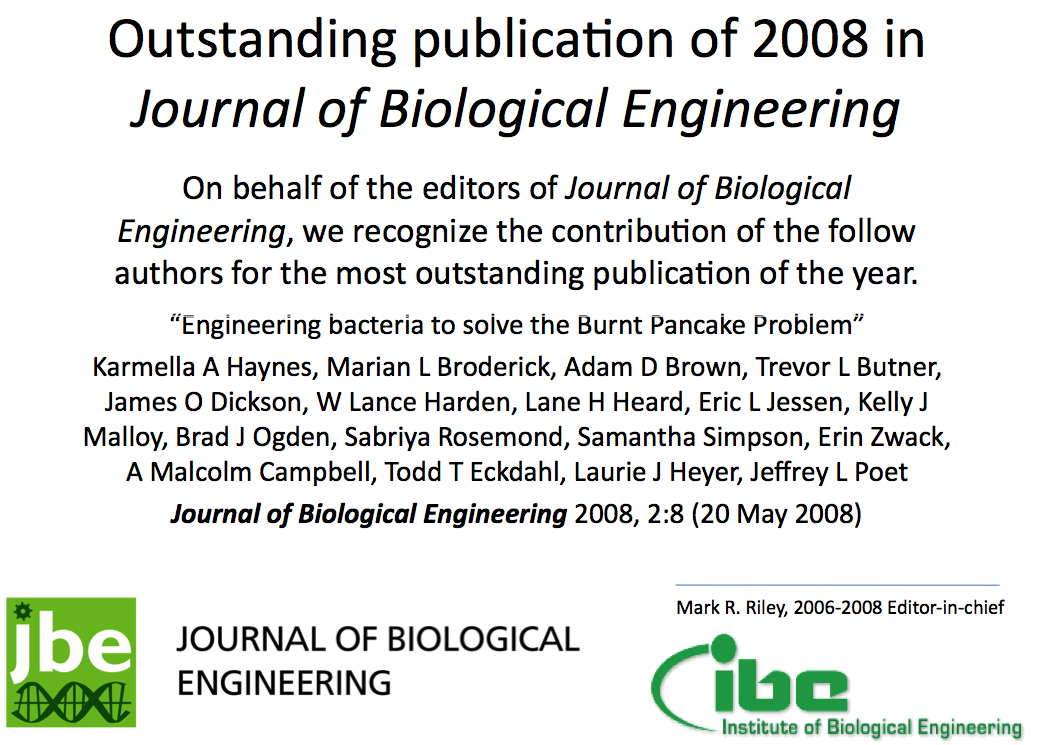
Haynes, Karmella A.,
Marian L. Broderick*, Adam D. Brown*, Trevor L. Butner*, James O. Dickson*,
W. Lance Harden*, Lane H. Heard*, Eric L. Jessen*, Kelly J. Malloy*,
Brad J. Ogden*, Sabriya Rosemond*, Samantha Simpson*, Erin Zwack*, A.
Malcolm Campbell, Todd T. Eckdahl, Laurie J. Heyer and Jeffrey L. Poet.
2008. Engineering
bacteria to solve the Burnt Pancake Problem. Journal of Biological
Engineering. Vol. 2(8): 1 – 12. JBE's
Outstanding Paper of 2008.Highly Accessed
Paper.
Todd T Eckdahl, Adam D Brown*, Steven N Hart*, Kelly J Malloy*,
Martha Shott*, Gloria Yiu*, Laura L Mays Hoopes, and Laurie J Heyer. Microarray
analysis of the in vivo sequence preferences of a minor groove binding
drug. BMC Genomics. 2008. 9 (32): 12 pages.
Gloria Yiu*, Alejandra McCord*,
Alison Wise*, Rishi Jindal*, Jennifer
Hardee*, Allen Kuo*, Michelle Yuen Shimogawa*,
Laty Cahoon*, Michelle Wu*, John Kloke*,
Johanna Hardin, and Laura L. Mays Hoopes. Pathways
Change in Expression During Replicative Aging in Saccharomyces cerevisiae. J
Gerontology. January, 2008. Download
data set.
Christine A. White-Ziegler, Suzin Um*, Natalie M. Pérez*,
Abby L. Berns*, Amy J. Malhowski*, and Sarah Young*. Low
temperature (23 °C) increases expression of biofilm-, cold-shock-
and RpoS-dependent genes in Escherichia coli K-12. Microbiology. 154:
148-166. 2008.
Nick S. Netzel*, Jillian L. Wisb*y, Pamela A. Marshall. 2008. Determining
Compensatory Mechanisms for Loss of Vacuolar Function in Saccharomyces
cerevisiae.
Arizona Nevada Academy of Sciences 52nd Annual Meeting.
Nick S. Netzel*, Jillian L. Wisby*, Pamela A. Marshall. 2008. Determining
Compensatory Mechanisms for Loss of Vacuolar Function in Saccharomyces
cerevisiae.
Arizona State University West campus New College Student Research & Creative
Projects Expo.
2007
K.A. Haynes, M.L. Broderick*, A.D. Brown*, T.L. Butner*,
L. Harden*, L. Heard*, E. Jessen*, K. Malloy*, B. Ogden*, S. Rosemond*,
S. Simpson*, E. Zwack*, A. M. Campbell, T. Eckdahl, L.J. Heyer and J.L.
Poet. 2007. Computing
with living hardware. IET Synth. Biol., 1: (1–2), pp. 44–47.
Madison M. Stevens*, Gary P. Lutz, and Consuelo J. Alvarez.
Gene expression of Sacharomyces cerevisiae exposed to commercial wood preservatives
by Microarray analysis. NCUR 21st conference at San Rafael , CA on April
12, 2007.
White-Ziegler, Christine A., Amy J. Malhowski*, and Sarah
D. Young*. Human
body temperature (37° C) increases the expression
of iron, carbohydrate, and amino acid utilization genes in Escherichia
coli K-12. Journal of Bacteriology. 2007. Vol. 189(15): 5429-40.
K.A. Haynes, M.L. Broderick*, A.D. Brown*, T.L. Butner*,
L. Harden*, L. Heard*, E. Jessen*, K. Malloy*, B. Ogden*, S. Rosemond*,
S. Simpson*, E. Zwack*, A. M. Campbell, T. Eckdahl, L.J. Heyer and J.L.
Poet. 2007. Computing with living
hardware. IET Synth. Biol. 1: (1–2), pp. 44–47.
Belanger KD, Tkachev D*, Geier SJ, Belanger KG, Aurora R. “Examination
of the Role of Regulated Nuclear Transport in the Response to Oxidative Stress
in S. cerevisiae.” Washington University Systems Biology Workshop,
St. Louis, MO. August 2007.
Belanger KD, Tkachev D*, Belanger KG, Geier SJ, Aurora R. “The karyopherin
Sxm1/Kap108 regulates gene expression under normal and oxidative stress conditions
in S. cerevisiae.” American Society for Cell Biology Annual Meeting.
Washington, DC. December 2007.
Mark P. Hamilton*, Padma Swamy*, Sun K. Park* and Lance
F. Barton. Dynamic proteasome regulation by PA28γ-dependent and
ubiquitin-dependent mechanisms. Department of Biology, Austin College,
Sherman, TX. 36th Annual Autumn Immunology Conference, Chicago, IL Novermber
16-19, 2007. abstract 65.
2006
Alison Wise*, Jo Hardin, Laura Hoopes. Yeast through
the ages: A statistical analysis of genetic changes in yeast aging. Chance (Publication
of the American Statistical Association) 19 (3): 39-44, 2006. Cover article.
Johanna Hardin, Laura Hoopes, and Ryan Murphy*. Analyzing
DNA Microarrays with Undergraduate Statisticians. ICOTS 7
(2006) 13E: 1-5.
2005
An Inexpensive Gel Electrophoresis-Based
Polymerase Chain Reaction Method for Quantifying mRNA Levels
by William D. Bradford, Laty Cahoon, Sara R. Freel, Laura L. Mays Hoopes, and
Todd T. Eckdahl.
Cell Biology Education. Vol. 4: 157–168. 2005.
MAGIC Tool: integrated microarray
data analysis
by L. J. Heyer, D. Z. Moskowitz, J. A. Abele, P. Karnik, D. Choi, A. M. Campbell,
E. E. Oldham and B. K. Akin.
Bioinformatics. Vol. 21 ( 9): 2114–2115. 2005.
Resetting of the Replicative Aging Clock in Saccharomyces
cerevisiae During Meiotic Prophase
by S. L. De Santiago, L. Cahoon, M. Y. Wu, K. Lancaster, M. McFarlane, J. Hardin,
B. Rockmill, L. L. M. Hoopes. Pomona College, Claremont, CA, and Yale University,
New Haven, CT.
(Presented at the American Society for Microbiology, 2005 annual meeting).
DNA Microarray-Generated Transcriptome Profile of Saccharomyces
cerevisiae Lacking the Tyrosine Phosphatase SIW14
by N. K. Minkah, B. J. Tiede, D. B. Kushner. Dickinson College, Carlisle, PA.
(Presented at the American Society for Microbiology, 2005 annual meeting).
Identification of Bacterial
Species Using 16S rRNA Microarray Technology
by J.C. Pierce, K. Patel, R.Khan, R. Shah, J. Greenwood, and A.S. Wenocur.
University of the Sciences in Philadelphia
(Presented at the American Society for Microbiology, 2005 annual meeting).
Diferentiation of Human Promyelocytic
Leukemia Cells: A DNA Microarray Analysis.
by Michael Roberts, Tasha Kouvatsos and Benjamin Tiede. Dickinson College,
Carlisle, PA.
(Presented at the American Association for Cancer Research, 2005 annual meeting).
2004 and earlier
Microarray Analysis of SIR2 Effects on Yeast Gene Expression
by M. Yuen, M. Wu, L. L. Mays Hoopes. Pomona College,
Claremont, CA
(Presented at the American Society for Cell Biology, 2002 annual
meeting).
Discovering proteins involved in the Saccharomyces cerevisiae aging process
using genome-wide analysis with microarrays.
by
Kuo, A, Yuen, M, Wu, M, and Hoopes, LLM. Pomona College,
Claremont, CA
(Presented at the
American Society for Microbiology, 2003 annual meeting).
Microarray Analysis of Yeast Aging to 12 Generations
by Laura L. Mays Hoopes,
Rishi Jindal, Jennifer Hardee, Michelle Wu, Michelle Yuen Shimogawa, Allen
Kuo, and Johanna Hardin.
(Presented at the Miami Symposium,
January 2004.)
Microarray analysis of early aging in yeast.
by
Jennifer Hardee, Rishi Jindal,
Michelle Wu, Michelle Yuen Shimogawa, Allen Kuo, Laty Cahoon,
Johanna Hardin, Laura L. Mays Hoopes. Pomona College, Claremont, CA.
(Presented at the Yeast Genetics and Molecular Biolgy Meeting,
2004.)
 JBE's
Outstanding Paper of 2009.
JBE's
Outstanding Paper of 2009.